


Introduction
Many couples reach a point where marriage no longer feels like a safe place to rest. It feels emotionally exhausting, distant, tense, or stuck. Two people may still live in the same home, raise children together, attend church together, and appear stable on the outside, yet privately feel as if their relationship is slowly losing its life.
That is often the moment when couples begin searching for Christian marriage counseling books, marriage counseling books, or faith-based resources that can help them understand what is happening before they make a final decision. A good book cannot force a spouse to change. It cannot replace licensed counseling, pastoral care, or immediate safety planning in cases of abuse. But the right resource can help a couple pause long enough to reflect, pray, communicate, and see the marriage through both practical wisdom and biblical truth.
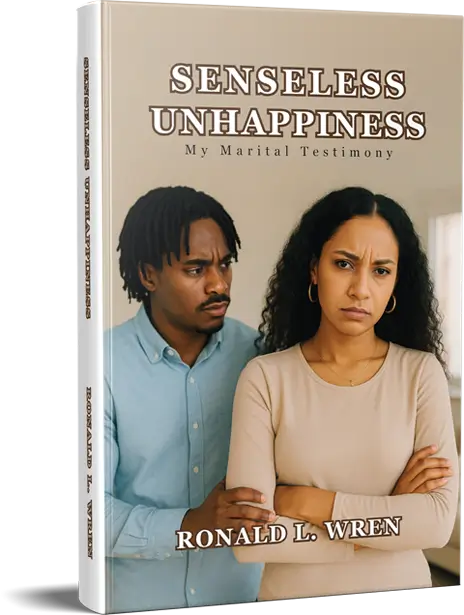
Ronald L. Wren’s Senseless Unhappiness: My Marital Testimony speaks directly to that painful middle place. The book describes a marriage “on life support,” where love may still exist, but unresolved hurt, conflict, silence, stress, and spiritual disconnection have made the relationship feel almost impossible to understand. Wren’s website presents the book as an honest, interactive, relatable, and spiritual resource for marriages in distress. (Ron Wren)
When a Marriage Feels Like It Is on Life Support
A struggling marriage rarely breaks all at once. More often, it weakens through repeated patterns that go unaddressed. One disagreement becomes a recurring argument. One unmet need becomes emotional distance. One season of financial stress becomes blame. One parenting difference becomes a battle for control. Over time, the couple stops feeling like partners and starts functioning like opponents.
In Senseless Unhappiness, Wren describes this condition as a marriage in “disrepair,” where a husband and wife may still be together but are close to giving up. He connects this unhappiness to areas many couples recognize: intimacy, child-rearing, home responsibilities, financial pressure, emotional stress, and mental well-being.
This is why marriage counseling books can be useful before a couple reaches the final breaking point. They give language to what many spouses feel but cannot clearly explain. A couple may know they are unhappy, but they may not know whether the root issue is poor communication, pride, unresolved grief, childhood wounds, financial fear, sexual distance, spiritual rebellion, or years of small resentments that were never repaired.
Christian marriage counseling books often help readers slow down and ask better questions:
What pattern keeps repeating in our marriage?
What am I contributing to the pain?
Where have we stopped listening?
What have we avoided saying honestly?
What part of our marriage needs professional or pastoral support?
Those questions matter because many couples do not need another argument. They need clarity, humility, and a practical path toward healing.
Why Faith-Based Guidance Matters in Marriage
Marriage is not only a romantic relationship. For Christian couples, it is also a covenant shaped by faith, responsibility, forgiveness, prayer, sacrifice, and accountability before God. That is why Christian marriage counseling books speak to something deeper than communication techniques alone.
Healthy faith-based guidance does not excuse harmful behavior. It does not tell someone to remain in danger. It does not use Scripture as a weapon. Instead, it calls both spouses to examine the heart. It asks whether pride has replaced humility, whether resentment has replaced forgiveness, whether control has replaced love, and whether silence has replaced honest confession.
In Christian marriage, ideas such as forgiveness, submission, sacrifice, and reconciliation must be understood with spiritual maturity. Forgiveness does not mean pretending the wound never happened. Submission does not mean enabling abuse. Sacrifice does not mean losing one’s dignity. Reconciliation does not mean skipping repentance, truth, safety, and change.
Wren’s work leans heavily into biblical reflection, but it also acknowledges that danger and abuse require action. In the book, he states that if a person’s life is endangered, they should flee such situations. That distinction is important for any trustworthy Christian marriage resource.
Faith-based marriage guidance matters because many couples do not simply want to stay married. They want the marriage to become whole, peaceful, respectful, and spiritually aligned. They want more than survival. They want renewal.
The Difference Between Reading and Applying Marriage Advice
One of the strongest truths in any serious marriage counseling book is this: information alone does not save a marriage. A couple can read every book, attend every seminar, and listen to every sermon, yet still repeat the same painful cycle if nothing changes in daily behavior.
Wren makes this point clearly through his testimony. He reflects that many marriages may have the information needed to help them, yet never put that information into practice. In his view, application—not information by itself—is what creates change.
That is a critical insight for couples searching for Christian marriage counseling books. Reading should lead to action. A helpful resource should not only inspire emotion; it should move the couple toward measurable steps, such as:
Setting aside time for honest conversation without interruption.
Apologizing specifically instead of generally.
Identifying one repeated argument and tracing its root cause.
Praying together without using prayer to correct or shame the other spouse.
Seeking a counselor, pastor, or trusted mentor when the conflict is too complex to handle alone.
Choosing one practical behavior to change that week.
Real change often begins when each person stops asking, “Why won’t my spouse change?” and starts asking, “What does God require of me in this moment?” That does not remove responsibility from the other spouse. It simply restores personal accountability, which is often the first step toward a healthier conversation.
How Senseless Unhappiness Speaks to Troubled Marriages
Senseless Unhappiness is not written from a distant, clinical perspective. It is a marital testimony. That is part of its strength. Wren writes from the inside of struggle, grief, reflection, and faith. He does not present marriage pain as an abstract topic. He writes about the emotional reality of conflict, distance, regret, family impact, and the longing for something better.
The book also includes a workbook-style approach. Its workbook section is described as a practical, faith-based guide designed to help couples reflect, communicate, and take actionable steps toward healing and strengthening their marriage. It combines personal testimony, introspective questions, exercises, and biblical principles for growth, reconciliation, and deeper connection.
That structure is valuable because troubled couples often need more than encouragement. They need guided reflection. They need questions that bring hidden issues to the surface. They need a way to talk without immediately falling back into accusation, defensiveness, or withdrawal.
Wren’s framework Rescue, Renew, Revive, Reconcile gives the book a clear spiritual movement. Rescue speaks to the marriage that feels trapped or near collapse. Renew points to the heart, mind, and habits that need to be made new. Revive speaks to restoring what has gone cold or lifeless. Reconcile points toward the hard but hopeful work of rebuilding connection where trust, tenderness, and unity have been damaged.
For readers looking for marriage counseling books with a Christian foundation, that framework offers both hope and responsibility. It does not suggest that every marriage will be restored simply because a couple reads the book. But it does challenge readers not to drift passively toward divorce, bitterness, or emotional resignation without first doing the hard work of reflection, repentance, communication, and wise support.
Conclusion
Christian marriage counseling books can help couples rebuild before giving up because they create space for truth. They help couples name what is broken, examine what has been ignored, and consider what healing may require. The best books in this category do not offer shallow promises. They combine biblical wisdom with practical reflection and call both spouses toward humility, courage, and action.
Senseless Unhappiness stands as a meaningful resource for readers searching for Christian marriage counseling books and marriage counseling books that address real marital distress with honesty and faith. Ronald L. Wren’s testimony gives voice to couples who feel stuck, emotionally worn down, or unsure whether their marriage can be rescued. Its workbook-style guidance helps readers move beyond simply reading advice and toward applying it.
For couples who feel their marriage is on life support, the next step may not be to give up. It may be to pause, reflect, pray, seek wise counsel, and do something other than nothing. That is where a resource like Senseless Unhappiness can serve as a timely guide: personal, biblical, practical, and grounded in the belief that rescue, renewal, revival, and reconciliation are still worth pursuing.
Quality self-check: The post naturally targets “Christian marriage counseling books” and “marriage counseling books,” aligns with the book’s testimony/workbook positioning, includes safety language around abuse, uses U.S.-appropriate professional tone, and avoids unsupported statistics or generic filler.